Tuesday, 18 March 2025

One round combat resolution using WHFB in OSE (weird playtesting stuff)

 Generally, I find that most combat in OSE and other games ends rather quickly, the longest I've seen is around 3-5 rounds, and the record for longest was 9, which was a massive pitched battle and lengthened by the advent of a player-character going insane from being possessed by an evil sword.

I always want it shorter, and I generally call for morale checks immediately after the first round.

I've also been playing WHFB(The Old World) and I decided to try using the Combat Resolution Step in games. The first test of this was in the game Aketon (review coming soon) and I have some thoughts, but first, a quick explanation.

As Aketon is a quick game where you start with 1 hit before you die, this was a great place to test this.

The general idea is this:

After one round of combat, run the Combat Resolution Step: Assign points/marks to each side based on the following;

+ 1 Ambush

+ 1 Outnumbered at end of combat round

+ 1/per Banner items (famous/magical weapons and armor)

+ 1 per wound (kills)

If there is a "Skald" or "Bard" character, win ties. If both sides have a similar character, ignored.

Loser must test morale, the typical 2d6 and try to roll under, but they add the amount they lost by. Loser must then flee, running half of their max walking movement speed, blind with terror, they will roll random directions at intersections in the dungeon. Enemies may attempt to pursue (slow moving undead, stationary enemies, and enemies locked to rooms like guardians or something will not be able to pursue). Catching a fleeing group means they are immediately and promptly destroyed or captured. 

Players really liked chasing people, they learned that sometimes it's good to not pursue, because in the final combat, they pursued into a larger room with even more enemies, and promptly ended up booking it, running into a dead end, and being slaughtered by rats. 

More testing to come.

Tuesday, 11 March 2025

Byzan Setting Primer #2: The Gods of Byzan

Note: This is a living document, subject to changes as I see fit/need. It is currently (March 11, 2025) incomplete.

The Gods of Byzan are extremely interested in the affairs of mortals. Many of the races in the world of Byzan were put there by the Gods, and they have vested interests in getting their "people" ahead, but intervention is costly and makes you vulnerable. They love using Champions to carry out their will.

The Rings:
The Gods are organized into three rings. This doesn't imply alliance or anything, it's mostly an organizational model for mortals.

The Calamity Ring:
Dagalur - The Great Betrayer, The 7-Eyed God. Dagalur is the patron diety of spiders.
The Flenser - The Cruelty -
Drjha - Lady Chaos
Govegh - The Ashen Whore
Bharraghur - Shatterer of Monuments
GhaitenGyaz - The Drakelord
Pax - The Desert called Peace. If there is a god of war, it is Pax, but Pax is more the outcomes of War than war for its own sake.

The Co-Operative Ring:
Rhea - The Broken World - Rhea was the primordial mother-goddess of the entire world, formless but known. The Towers and the Charting of the Empire has driven her mad, and very few do know her name.
Drjho - Lord Order
Radegh - Guardian of Oaths, Rememberer of Curses
Molly - Lady Luck Herself
The Heroes of Kheev - Patron God of Kheev
GirDaga - The Roadmaker, the Bridgebuilder
Yodhzt - The Nobless Oblige
The Wretch - The Lying Name of Empire - The Wretch is the imperial cult of the Byzan. It loves control. It loves hegemony. It loves monopoly. It loves subjugation and greed and terror. It is an appetite, nothing more.

The Mysteries:
Dagatmyr - Life, Cycles, Rebirth
Halci(Nergal) - Lady Death Herself
Sol - The Unconquered Sun
Lund - The Unstoppable Night
Dagnyala - ?
Control - Homes, Hearths, Eternal Mountains, Promised Lands
Catche - ?

Byzan Setting Primer #1: The Empire

Note: This is a living document, that is always subject to change.


The Kharmlund Campaign continues. It's been going for almost two years now, and there's not much in the way of any indication that the players are getting bored. It helps enormously that my players aren't boring people to run games for, but that's another topic for another post. Today, I just wanted to get some of the 'lore' down, something I've kept loosey and goosey for the purpose of being able to slot in things that are and aren't needed. I like to use miniatures in my game and I pick and choose as I please what to include. 

However.

The setting is meant to 'feel' very Greco and Roman, and I've massively increased my reading load since then, I am in fact reading The Illiad, and will continue with The Odyssey and The Aenid and various other things alongside many many many history books. For all of the hatred towards Dr. Beard, she has written Emperor of Rome, which is easily one of the best books about the Emperors, what the position entailed, etc that I've ever read. Mind you I've only read around ~15 books on Rome so who knows, I may be ignorant. There's more great books on Rome than I will ever read.

Anyway, let's go.

The Empire

The Empire is Rome, for sure, and meant to feel like it in all but name only. However, it isn't called Rome, and doesn't have an official name besides Byzan which is kind of a word for cattle in the name of the Vosdht, the people that rule the Empire and benefit the most from it's conquests. 

Byzan is ruled by the Khulmar, an Emperor-figure, and they are, in my current campaign, reaching the end of what can be fairly called the princeps model, a citizen-Emperor who is meant to seem(but isn't) accessible to the common man. Myths are put out about this all of the time, and there are overtures to being willing to listen to what you'd call a senate, however the Khulmar does whatever it wants and only needs to fear reprisals from assassinations and usurpers and uprisings and such, the Khulmar more or less just needs to balance the anger of the citizens versus the anger of the nobility and their own personal wants and needs. Not every Khulmar is a selfish bastard, but make no mistake, these are autocrats, and even the kindest Khulmar is a monster by most standards. 

The Vosdht are orcs. In a pinch, Orcs are a great visual short-hand, however I sort of just designed them to be like the Aumaua from the Pillars franchise. They are very tall, averaging 6-8 feet. Large sharp teeth. Boisterous, deadly in combat, and deeply arrogant. Not as a racial trait mind you, but when you have the largest empire ever seen, well...

Byzan has managed to spread with a rapidity that impresses most, and they do so due to a mixture of slave labor, and the Dorfngir, or the Dwarves. As per my previous post, Dwarves are weird peoples, and care little else for anything but finding their bazngir and then working at it forever - they also live forever doing this, so like ant colonies, they eventually reach a critical mass of work to be done, and then future Dwarves born are sent out to the wide world to find work to do. The Vosdht are very okay with this, since to them, many of their infrastructure acheivements are just done by Dwarven hands. The Dwarves, toiling endlessly and happily has given the Vosdht a strong philosophical basis for the justification of slavery - look at the Dwarves, that's an entire people that exists to be a slave for others. The fact that Dwarves typically don't consider themselves slaves, and will do this work for basically anyone they come across isn't openly acknowledged, and Dwarves rarely bother to speak with other peoples except to place orders for materials, tools, bitch them out for erecting scaffolding incorrectly, etc. 

So the Empire conquers. It spreads, and each successive Khulmar is required to be more aggressive, violent and conquest-lusty to stay in power. Where will it end?

The Forges: 

Byzan built these all over their Empire, with the help of their Dwarven subjects. They are massive towers and approaching them is forbidden on pain of death. Important: they are generally assumed to be cursed by anyone that discusses them with the Empire, and nothing wipes a smile off the typically jovial Vosdht than bringing them up.

The Races of the Empire:

The Vosdht are the first and primary citizens of the Empire. They live everywhere, populate the regions they conquer with colonies, protection from their legions and so on. The second largest demographic is the Dorfngir, or Dwarves. They're anywhere they're a public works/engineering project, and they tend to form colonies around them. The average "inn on the road" is actually just a Dwarven colony that also services travelers while being built around servicing and maintaining several miles of road. These colonies are called kharmgir, or, "home for work" or "work-house" whatever you want. The Epigones(or Elves) are smattered everywhere. They will get their own post soon, but needless to say, the 'race' of Elves insert themselves everywhere. Halflings are more rare, and generally despised by other races, as most acknowledge them as being the 'children' of the moon, the evil god Lund. However, they are often enslaved as jesters and pets and other things. There are still some places here and there the Halflings simply live normal lives under the Imperial yolk, but their future is in doubt. 

Finally, there are the Men. Men are wandering tribal bands of nomads. They have a shared language, religion (worshipping Radegh, the Keeper of Oaths) and generally find themselves doing merc work if they're not farming for the Empire. In many battles in these ages after several devastating plagues, some note there's more Men fighting in and against Byzan than anyone else! 

The Eastern Provinces:

The East is a smattering of major cities and other provinces. Well developed Vosdht cities, many men live here, and the Empire is often called a different culture entirely. There's meant to be parallells here to the East of Rome, and they do have easterner allies that are constantly causing them problems, but there's no worshipping of the culture and philosophy of the people here. The Byzan did not write an Aenid which exists to prop up the legitimacy of them as some kind of super-successor state that also functions as a literal sequel to famous eastern poems. The East will be developed later, but that's the general idea. 

Sunday, 5 January 2025

A Review/Critique of Dragonslayer (2024 TTRPG)

Once again I emerge from the depths to begin the year with....*waggles fingers* a review! One that is quite late, as it's delivery was delayed by the canadian post office worker's strike by about six weeks. The wait is over! Kharaz! Bazngir! It's time to inform people about this game, that I think is pretty damned good.

Dungeon Crawl Classics:

I don't like Dungeon Crawl Classics. It's a fine system, but a fairly incomplete one, more interested in writing lengthy spell entries that spill haphazardly across pages and has the absolute audacity to put "dungeon crawl" in the name, and then have no actual dungeon crawling procedures and rules, mostly just muttering that you already know what those are and how to do them. 

Dragonslayer feels like an RPG written by someone who set out to write Dungeon Crawl Classics but had a bit more thought and care into how exactly how the game would play for lengthy campaigns and be a good, nostalgic DnD-esque game without quite being just, well, ADND or B/X

Funions:

The game has a very good approach to writing a TTRPG I haven't seen in awhile, and I am going to sound insane when I type this, but it actually attempts to teach you how to play the game and offer best practices. A lot of these games don't. Some are well meaning but not great (play examples that offer a generic battle and/or dungeon crawling procedure) some are neutral (a list of procedures, random outcome tables with no real context to string them together) and then some are just worthless (anything that tries to write vibe-based poetic language, ie "How to run a DarkMurder RPG game? Be the call in the dark, the laugh of a harlot, the grin of a killer slitting throats for copper", garbage like that). Dragonslayer isn't really doing any of that, and instead provides some humorous and useful advice on how to play and run the game.  It comes up in a variety of sections, the first being it's own admonishments:


 DnD as War:

There's an interesting idea that the purpose the GM is supposed to kill you and as a player, its specifically your job to prevent yourself from being murdered. You are flat out told to set yourself up in ways that make it hard for the GM to kill you, like you're playing a strange wargame. Dragonslayer is part of the "DnD as War" school of GMing, in the sense that learning how to conduct a war intelligently is as useful as reading the manual, so denying engagement when you can, scouting correctly, supplies/logistics etc are all equally as necessary as being able to pull off a good tactic. Tricking orcs into blundering into their own traps, making alliances with various factions in the dungeons and making sure that at the end of the day, your characters are assuming the least risk and shooting for the most reward is what you want to do. 

Easily some of the best advice I've ever read on how to play lower levels. None of this is actually new, but it's rarely codified.

However, for some reason, there doesn't appear to be a reaction table provided, so there's a breaking here from older-schools of DnD: you are expected to get a lot of killing done. I will be running with reaction tables, but it's a baffling omission, especially since the game tells you this: 

I firmly believe that DnD simply cannot be a good dungeon crawling game without reaction tables, they are the lifeblood of the Dungeon Game. You can argue that you can simply roleplay as the Maze Controller and such, but I mean, come on.

Despite this, a reaction table is easily added in. Still. Why? Why why why why? 

"Hardcore":

The game isn't that brutal, despite it's as-war philosophy. Scores are 3d6 - but not down the line, arranged as you please, and with seven generated and the lowest discarded, making character creation somewhat easier. No race-as-class, but also no "reroll your character if their modifiers are terrible". Greg gives you more chances to make a better barbarian, but would like you to at least try to roll with the crappy guy you got if you do roll one, as he says, there's always the fighter option, and he is pretty damned good:


That cleave ability, seen in other games like ACKS really does give the fighting/martial classes an extra punch, and make it so that, alongside incredible saves, they're genuinely valuable in the in early, middle, and late game.

There are 'fast packs', which are just objectively good ideas for starting equipment, something I noticed in 5e and don't really have an issue with. You don't need to do this but it makes making new characters easier. Some other things are that the new race provided - the cyclopsman, is a pretty interesting idea. Not great for archery - their lack of a second eye causes depth perception issues, unsurprisingly, they have other things to help with it - darkvision, immunity to poison gas but drop dead from drinking booze(with a save, as is right). Otherwise, the races provided do the 'standard' - Dwarves are hardy with huge boosts to saves, Elves are quick and good with magic, and humans can do everything. Again, it provided a "role-play" quick guide on how a member of that race would act - not new, but useful to the new. 

Magic users are much more different than I expected, with them starting with six possible spells(!), three of the same spells that are useful spells, then you roll for the other three in offensive, defensive and utility categories. You still only get one spell/day(higher int gives you an extra) but still, you get much more stuff to think about when memorizing your spell for the day. There's a hard limit on spell memorization - without magical items, you may memorize one(1) spell of each type for the day, so you must bring a varied toolbox, and not multiple casts of sleep or magic missile. I like this. It makes for varied play.

Onward

The adventuring rules are pretty standard b/x procedural play, they even come with an adorable pinwheel time tracker if you so wish. The game incorporates a critical hit and miss system, but it's very restrained:


I dunno guys, maybe this should have 1d30 entries, each less usable at the table than the last!

Otherwise, combat is not that punishing: there's an optional death + dying table a lot of these games add in to make the game less about the meatgrinder and there's a wound-binding mechanic for after battles, so again make healing much easier instead of the normal taking multiple days to heal oh later game. There are miniature rules. They're fine. They get the job done, but this is not a miniatures game, and while I plan to personally use miniatures for occasional big setpieces and such, these are merely competent miniature battle rules. Still, it's nice to have them at all, if I recall correctly, certain companies have written similar rules then charged full price(!) for guidance on how to use them. 

The tl;dr is you basically already know how to use them.

Now to finish up there's some generally useful GM stuff in here - there are great rules for stocking dungeons, generating dungeons, placing dungeons, a quick and dirty tutorial on hexcrawling and how to design your own small adventuring zones. Very telling this is not ACKS - you are shown how to generate a 5x5 hex zone and given the same general guidance that Gygax did - put a hamlet or base or castle or village for the PCs to rest and recuperate and sell loot in, and then put the dungeon a hex or two away. It's good advice - again, not new, but useful for the new - and that's a problem a lot of these B/X clones struggle with. The worksheets provided for the dungeon are especially fantastic - but that leads me into the final observations of the game...

It's What Worked Already:

Dragonslayer isn't doing a lot of very new stuff, just being good and decent at what it is. A lot of the great rules I really enjoyed are just rules that were in his megadungeon projects already. Runestones, spellstones, etc are all there from Dwarrowdeep and they were a good series of ideas, and wouldn't you know they're good enough to add in here. The dungeon generator is fantastic but it's just a buffed up crypt generator from Barrowmaze. This isn't a critique, by the way - these are just good things that are already out there. It's not the ur-OSR, it's just Gygax codifying what Arneson had already written, but it's Greg doing it for Greg. I guess that's a weird comparison, but this feels much more...authentic than some other games. I guess that's probably why it came out and people just gave it a big shrug. It's good stuff but this Good Stuff isn't new, the stuff that is, is the tips and tricks stuff peppered throughout the book. The Wizard 101 section is good enough that I'd honestly be willing to pay for a booklet of these for every class, and honestly, it's refreshing to see people provide, well, a lot of concrete examples on how to correctly adventure in an adventure game. 


Final Thoughts: It's good. It's not super new, but very reliable, and will provide a deeper game than something like OSE while not being as punishing. An excellent game that really only suffers from missing the reaction table (????) and 'suffers' from being a really good game with decent art. I guess people were wanting more fanciful layouts and such. Oh well.


Tuesday, 3 December 2024

Mike Mearls does not understand B/X or OSE


I was merely enjoying a proper mountainous lunch of cheese, meat, bread, cheese, meat, beer, beerr cheese and meat with some bread on the side when upon scrolling the ol' timeline I happened upon the X account of a man named Mike Mearls, of some repute or disrepute. Please understand goin' forward that I'm not interested in commenting on his pre-pandemic reputational woes and curious associations with some people, but rather this completely horrific post he made about adding complexity to the best of the old 70's Dungeon Games, the basic/expert rules (and OSE).

I've been running OSE bi-weekly, with very few stops except for being sick or holidays that supercede the important Dungeon Game, and even though I stopped writing battle reports (they were too much work, and thusly, I renamed this blog), I can tell you we're at session 30~ and are taking a quick break, as the domain play stuff requires a lot more work and the players wanted to try some Mork and Borg, a simpler game with less procedure. The reason I tell you this, umgi, is because I don't really mind what type of DnD you play. I play various versions of the Dungeon Game, and this single-page-of-rules game is a good palette cleanser for the next chapter of the Kharmlund(now call Lunaralia) campaign, because we're full on into domain play going forward: leading armies, handling diplomacy, and finally - to my horror - leaving the starting hex as the spider-god worshipping half elf Ildaberd prepares to make good on his plan to march on the Capitals and claim the Empty Throne, becoming the 9th Khulmar and assuming control over the crumbling and in disarray Byzan Empire!

Uhh, what was I talking about? Oh right - Mike Mearls. Let's talk these tweets.


I'm already worried. Maneuvers. Continue Mike.


Ah.

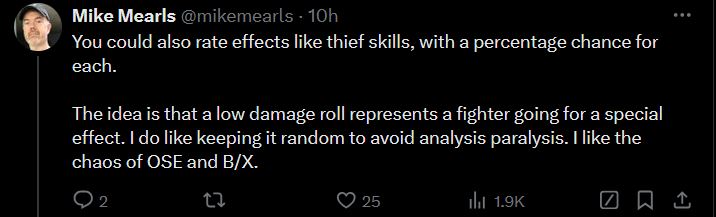
These are horrible, horrible ideas for Basic/OSE. The mechanics themselves are fine - they are good mechanics for the kind of game that Mearls wants to play - which is not BOSE. Mike wants to play something more akin to 4e, or maybe Dungeon Crawl Classics, since he makes this baffling comment about the "chaos" of OSE/B/X:


So let's just make something clear - in terms of raw chaos, there's very little inside the intended play session of BX/OSE, it's just not there. Spells are largely deterministic, with set and specific outcomes (some spells have random tables, but this is not dungeon crawl classics or WFRP where random effects are rolled on a table frequently). Combat is very tightly ordered and despite my proscription against telling players stats of monsters, you can immediately tell, especially until level 5-6, exactly what an encounter is going to do, most of the time. Lots of low-level monsters are bugs, beasts, humanoids with no special abilities(maybe 1) and there's no chaos there outside of the normal play.

So, with adding "maneuvers" from more modern systems into BX: you can do it, but it defeats the point. With zero irony, just play something like 4e or maybe one of those RPG/Wargame hybrids(they are fucking awesome), since you don't really seem interested in playing a game without combat. I've run 30 sessions of this BOSE campaign, and it has happened that we've gone months without actually rolling initiative - the players commenting on how long it's been since they had to actually, uh, fight someone despite plundering tombs filled with monsters. How weird! 

So while I say you can do it - it completely misses the point: combat is not something you really want to get into in BOSE, and more importantly, the fighter is already fantastically equipped to handle it if you simply must fight dudes. They get the best saves, the most health, access to any weapon, any piece of armor (and with these two, the highest amount of magic items), and rapid level progression - the fighter may not be fancy, but he is reliable. The hank hill of adventuring parties. He might be boring, but he's the one that gets you out of scrapes.

That doesn't mean you should fight dudes, most people that survived the adventuring profession in the Dungeon Game didn't survive it if they simply chose to Engage The Enemy at every chance - that was how you died. It's video game shit to shrug at 30 goblins attacking you, something that should immediately cause you to shit your pants and run screaming in the opposite direction. In modern systems, you just activate your turnabouts while making sure you have enough verse tokens while spending your hope and luck and fate and valor and fortune while making sure you fear and doom and rage and bane and disadvantage doesn't go too high. In BOSE, killing 30 goblins is, "I knew there was a reason I didn't use those two sleep scrolls and you call kept screaming at me to use it on the minotaur well look who is laughing now assholes" and in modern games it's a warmup. I don't even mind these kinds of games and I have played them and I like them. However. In a game where the reaction roll, the light of a torch, and the caution of a player massively change how the game is played and how encounters go out. My players have toppled bandit kings, screeching hordes of skaven and more by learning how to speak to - then manipulate them. The Skaven are self-defeatingly paranoid and stupid? That's a weapon. The bandits are so gold and glory hungry they'll walk into an obvious trap? That's a weapon. It makes monsters so much more interesting in BOSE - it's also a big part of the roleplaying.

I see a lot of RPGs that get advertised that basically just try to make you play more like BOSE by forcing stuff that seems fairly obvious and comes out naturally into mechanics. They'll go "in THIS rpg, monsters are MORE than just stat blocks, they have LINKS in a CHAIN that you can BREAK to make them FRIEND or FOE and figuring that out requires you to use your abilities, like your SLEUTH tokens" or whatever. That stuff was already there. The fighter is capable of pulling off some crazy shit with just "attacking and defending", and I would know, I gm'd a section where a single fighter (with a magic sword and set of plate) held off a teeming horde of Skaven off, backing up every time and buying the party time to make it to the teleport out of the dungeon with their stolen magic items (of vital importance to the ratmen). As he finally broke and ran, he picked up the poisonous gas bomb he'd found in their lair as swarms of rusty spears cut him up, and nearly killed them, tossed it, and teleported out, killing almost all of them. All of that was just him doing cool shit, but mechanically it was just a basic attacking and movement set of rules. Maybe I could have made that more possible by adding in Steer The Narrative tokens that allowed him to use the Gas Bomb ability, but he'd had better watch out because that moves the party up the Ruin track and they'll need to spend a Repose to Clear Down their Ruin or the GM will be able to spend that to unlock a Hefty challenge (rated such because it can cause three Surges worth of damage), thankfully he was able to Jaunt out of there as the Door to the Maze of Adventure was met and the players could simply declare the dungeon cleared as they'd gotten enough Keys from using their Scrutiny spends.

And again, listen, I don't mind those things, and I'm not offended by the silly games that do them. I've played many of them over the last two years and I like them - but they're not BOSE. Because my players also defeated a bandit king obsessed with power by convincing him to put on a cursed diadem that enslaved them to the party by playing their cards right. They've been not so keen on pitched battles but used an old plague-afflicted stone to drop it into the enemy camp's water supply. They've managed to broker alliances with powerful, dangerous, violent people, all through trickery and other things. And that's the kind of stories B/X was built on. Conan didn't just charge in and start killing people. He was a smart guy. So building games where a guy can kill 30 goblins with stupid extra, pointless mechanics just aren't the 1970's Dungeon Game. They're something else - and so is whatever Mike is trying to turn BOSE into. You can play them if you want, but...my dude? That's not BOSE. That's something else. Just play 4e man. It's a great game, and it's honestly where you seem to want to be. 

Thursday, 18 July 2024

On Dwarves

Note: The following piece of lore is written from the perspective of a Byzan Empire merchant who has traveled around a bit and knows some things. There are always biases in every telling and not everything here must be taken as truth. ***

Purpose:

Suppose you're working a project. Likely, you're from a village too poor to have slaveholders and you're in charge of building, let's say, a bridge. This bridge doesn't need to be much - it just needs to be larger than the felled tree people have been using for a couple decades - the tree did a fine job - but it's just not quite what the merchant class needs to bring goods to you. So you're probably the most learned member of the village, and you're beginning to get the work started with a crew of volunteers when you're tapped on the shoulder. You turn around and look at a man, maximum height five foot nothing, round like a boulder, arms bristling with muscle, beard down past his knees and wearing some kit that looks like it was harvested from a motely of large insects. He asks you what you're doing. As you begin to explain you're making a proper bridge for your town he seems to enter into something of a trance, then begins grumbling and pushes past you, tsk-tsking at your crew, tools, material, plans (if posted) and then rather gruffly tells you to step aside in the same tone an overbearing father takes over his son's science project. As you stand back and watch this man take over your project, if you're learned enough in the ways of the world then you're a witness to a young Dwarf getting his "purpose" or "bazngir"(great/important work).


Before you accept this, let me tell you a few truths about these people.


Dwarves like to help:

At first this is going to seem amazing - not only are you getting a free bridge, it will usually be grander than original plans. There will be a toll, and there will be a drawbridge mechanism, allowing you to raise the bridge with pull of a lever. Hell yeah! The roads leading up will be cleared, and overall you will have a bridge that would be the envy of the Capitals. 

However.

If someone from the Capitals were to arrive at your place, take a look at your bridge, he would, to be cruel, snicker at you and congratulate you on your good fortune. If he was to be kind he would pat you on the back gently, like he was offering you sympathy. 

Other Dwarves will arrive. They will take up the support roles, usually in what appears to be an angry confrontation - do you have a place to sleep you idiot - no I'm too busy, but someone should get on that and stop whining about it - well maybe I will, asshole - and suddenly an entire colony of Dwarves will be on your town's outskirts, an entire cottage colony built around the "bridge project". They work all day, they sing songs (mostly about working hard, and how much they hate spiders), they brew and drink ales, and generally keep to themselves. They dig out new mines to provide materials for the bazngir, they cut down forests for the bazngir. Yet - they do not contest leadership of the town over anything except what pertains to the bazngir. You can even tax them - this of course will lead more dwarves to the city to find their own bazngir to provide gold, gems, silver, anything the town wants. The people will grow rich off dwarf labor - far faster than off slave labor. 

Dwarves like to """help""":

Astute men and Vosdht will note that while the bridge is an amazing project, when it's "finished", it's not really finished. Dwarf materials are great, but must be replaced often, and generally like most Dwarf works, must be fussed over constantly. They seem to love this, and the girthegn(work leader, closest thing to a noble they have) will be himself constantly puttering and tinkering and muttering and fidgeting. The work never stops and while the benefits are great - the work never stops. Designed a better bridge? Sod off. We built a better bridge upriver that doesn't need to be worked on forever. Sod. Off. We have advanced technologically to the point that we have flying cars and no need for such things. That's fine - we don't care - we're going to keep working on this bridge, some of the east supports need reinforcement again. At some point the Dwarf bridge just becomes a liability, and the lands they've cleared and settled become enticing...

And what are these things, anyway?

The Dwarf that first got his bazngir from this will still be alive, after many decades, showing no signs of aging. He will, in fact, as long as he has his bazngir, will never die, unless he is slain. If the work was destroyed and couldn't be started up again (buried under a landslide, for example) the Girthegn will start to age normally, and not live more than a decade. After a time, all that will be left will be the great tombs of these people, with usually one Dwarf who found his Bazngir was to protect his people's wealth and remember what was lost. 

But I'm sure you're going to be fine. After all, you're getting a free bridge. So let them help. They like to help. Who do you think built all of our Empire's roads, aqueducts? 

...

Do you think it


was wise to build an Empire on such a foundation?

...

Anyway, I've got a lot of other places to visit, thank you for your business. Good luck with the bridge.


Sketch of Dwarf in traditional armor(chitin)

***Obviously this is just my weird little take on Dwarves, I make no aspersions on your settings or worlds..

Wednesday, 15 May 2024

Return to Dark Tower RPG: Components/Quality Review + What It's About


I love Return to Dark Tower.   Having played 13 times with a group and 6 solo, I can safely say it was worth the money, especially since people still like it, want to play it, ask about it, etc. It's a dub. I recently bought sleeves, token upgrades, and the Hordes miniatures upgrade because, well, why not? I love this game. 

There's an RPG. I liked the base game, MAZES enough, so I figured, with a bit of extra cash in my pocket, I would pick up this game. I also bought everything for it, because nobody else seems to have, and it needs to be reviewed. 

 tl;dr This game kicks ass. Before I get to the meat of the RPG, I'm going to review the accessories. With photos!

DICE TOWER ACCESSORY / ROLEPLAYING KIT

I am very mixed on this one. It's got what I would call a mixed value. 

The actual tower itself is cardboard, and it's got one of those covers, very nice colors and glossy. Cardboard is hard. It wouldn't hold up your weight, but it's thicker than like, cereal box. Probably just a little thinner than say, the Leviathan box for GW(any of their thick boxes) similar. It's sturdy, has valuable stuff on it. 


Behold! The Tower!
This is a tracker for keeping track of a metacurrency the GM gets
This is a list of all of the results of the reinforcement die
And here it is again. Probably could have left this side blank but there it is again.

The top half and the bottom half have magnets on them so the tower stays together and you can rotate it to face you. I actually really liked this.


This is the "resolver" that tells you what rolls you need to make to do what actions. More below.

However. The actual tower is not functional enough as a dice tower, as it works about 90% of the time. There's an insert you put in the "top" of the tower, and a tray you put between the top and bottom. Your dice emerge from the tower from a front door, and while it didn't happen a lot, it does happen that the dice, even when dropped to give them more energy to bounce, in my testing, did get stuck a small amount of the time.


Tower's center. The dice got stuck here a couple times in testing. Hm.

 I dunno man. You can get dice towers. You don't really need them unless you have asshole players who will literally throw their dice across the room without one. If you know someone with a 3D printer, you can get them for a few bucks and there are free STLs everywhere. Even a 3D printed one from an online seller should be relatively cheap. I dunno. It's not great. The cheat-sheet elements on it are fantastic. The value it adds? I don't know. Because while that's useful, the system is so simple that they put these cheat-sheet elements everywhere. It's not great. 


 Dice! For all your needs.

The dice included are fine. They're colored to match the palette of the original game, but unlike the official MAZES dice you can buy, they are not coming with little symbols on them. The official dice come with crowns and keys, this one should honestly have come with the banners and reinforcement symbols. Disappointingly, it did not. They're fine however, and if you're a Towerhead(I am coining that term) there's a variant, gold colored reinforcement dice. It's the same quality as the RtDT game.


 Basically shorter but longer than an index card and too much info crammed in there.

The sheets included are garbage. They include the tally sheet and the main character sheet, but they're tiny, and the colors, bright and vibrant in the books and basically every other accessory, are washed out here. They're double-sided too, and they're just too goddamn small. Second picture is it on top of a 6x4 inch MDF board I'm using for Hobgoblin move trays. These add zero value to the product. Complete waste of time. They will never be used at my table, holy hell. 


The tokens? They're almost exactly the same as the ones for the board game. I've included one of each of the board game tokens. Slightly smaller, good thick cardboard, they're fine. 

The last thing is the cards. These are awesome. Nice, thick cardboard, glossy, they come with player aids:

- Resolvers for the game (this limits the value of the tower) but also include the "scale"/mass battle resolvers

 - A card for every single pre-built hero in the game, which are all of the heroes in the expansions and base game. Just fantastic, you could hand out blank sheets then just let people choose characters based on their art alone, then fill out.

- A card for every board game Adversary(final boss) and every board game foe(normal enemy)

- Player aid for the darkness metacurrency and explanation on the back what it does. 

- Player aids for every single march action in the game and for bonds.

- Player aids that list all of the named locations, one of each for each kingdom(if you don't have space/interest in the map)

The cards win. They're the best thing here. They do take away from the value of the rest of the package. So if you want to buy this thing, it's 50 USD. The tower works 90% of the time, the character sheets are garbage, the dice are perfectly fine but lack official branding, the tokens are high quality and the cards are probably the best RPG player aids I've ever seen. Value is up to you. It will look cool on the table.

Adversary Screen

The Screen is a typical GM screen. Same thick but not heavy cardboard, glossy, some art. The front has the tower on it, which is a good choice and a couple monsters. It's up there. I like the thing. 

Otherwise there's not a ton to say. It's cheaper, but you know. I don't use GM screens, really. 


Okay, now to the meat of the matter...


Before we can talk about this game, we have to talk about MAZES. MAZES is an RPG system that borrows a lot of "story game" elements and is full of references to other works.

It uses the Polymorph system. The system gives each player a sigle die - d4 - d6 - d8 - d10, and that's basically your character. There's four types of checks, Books for brain stuff, Boots for agility things, Blades for murder, and Bones for any sort of physical save or strength check etc. The numbers as you likely have seen with the resolver are static. There's Edges to give you more variety in your build, and when you roll the "1" you succeed if the check has something to do with your die type. The highest number on your die is an auto-succeed - but as the GM accumulated metacurrency, namely Darkness - it goes from autosuccess to negotiated success, to never working and becoming an autofail. It's a fun little system, not really built for leveling up but good for telling stories in shorter campaigns. There's spellcasting which uses the dice but there's a lot of abstraction here and it's more about the fiction than the dice. So if you're a fighter(d8) you're going to roll the 4/5/6/7 to hit people a fair bit, and during the start of the adventure you're going to autosucceed a lot. You can fluff this as a battlemage throwing fire bolts or a guy stabbing people. "Blade" is not literal, it's combat. Not a bad idea. There's a health system, you don't get a lot of health but enemies don't do a ton of damage, and the game is sort of designed around you spiraling a bit the longer the adventure goes. You wouldn't go into Kharmlund here but you might want to check out Gahamenzant, my Lankhmar-esque cit1y setting. Never Conquered! So what's different about that compared to here? This is a good system for first time roleplayers, kids, people who just want a small amount of mechanics. It's horrible for people who want any sort of granularity. Like, treasure/inventory is a metacurrency you spend if you have it, you don't mark down 100 gp, you mark down 1-3 treasure points or whatever, and that's a communal resource.

Compatibility

This is so compatible, mostly because the system itself is so simple/good. The book provides specific page numbers and gives clear instructions on using everything from MAZES here and vice versa. Honestly? The word I would use is "fuckin' stellar". I am aware that's two words. 

Map


There's a map. I don't like it, it's just a paper map, and if you're buying this, you have Dark Tower. So use that, or the tally sheet which has the regions listed.

Lore

They added lore. Or this is the lore and I didn't see it in the manual. There's not a lot here, basically Nagash's backstory - evil wizard made a big evil tower, got betrayed, died, and now the Tower is just a big pile of "fuck you all" in the center of the continent ruining everything for everyone. I like it enough, the framework lets you add lore in and out as you please. They did explain what all of the monsters were now, which is nice because people going "what is a mormo" got really annoying!
 
Mechanics
 
So, it's MAZES. The game works the same with some added fun stuff. For one, the "key" is now a "banner" action. It's the same. The crown is now a "reinforce action", and it's the same, but if your "forces"(basically a personal army that follows you around, more below) would help you succeed at it, you get it. It requires negotiation at higher darkness levels like in MAZES and it fails at the highest levels of darkness. So its not bad.
 
The Darkness mechanic is a metacurrency. You spend it to do GM fiats or to make the permanent Darkness level go up. You get Darkness by getting it through end of session tally ups. You also get it by having players get dropped. In MAZES there's "conditions" but its a bit different in Dark Tower. You can also negotiate Darkness, like if the players (who are supposed to always be good guys) do something evil, fail a mission, etc. I'm still relatively new to metacurrencies but I don't really see any mechanical weaknesses here, yet. Rising Darkness is a permanent spend. It's the stuff that makes life harder for you. 
 
Mass Battles

There is an interesting mass battle system. I don't necessarily agree its the best way to resolve these, you should just be rolling down the neoprene mats, pulling out your armies of miniatures and having an epic fucking final battle. Alas, this is also fine. The mechanics basically just get another set of names: banner is the same, books becomes tactics, boots becomes march, blades becomes battle, bones becomes defend, and reinforce is the same. Still, it's a nice attempt at doing a mass battle, similar to other OSR games that just sort of say "do a normal fight but say it's a battle".

There are new metacurrencies that mostly function the same as the old ones. There's Spirit, and it does the role of Stars in MAZES. Spirit is casting "big" spells that wouldn't be cantrips, pulling off heroic actions, succeeding when you should have failed, overriding GM fiat. The d4(paragon) character gets four of these. The d10(sentinel) gets one. Treasure is the same as MAZES no changes. That's fine but it's a bit disappointing there aren't like...coin tokens or something. Then there's danger, which replaces the "hearts" from MAZES. Hearts functioned as HP and you spent them to both attack and absorb damage. Now, you take "danger". When you take a "danger" you roll. If you roll above, you're fine. For now. If you match, you're removing all danger, and getting an additional action. If you roll lower, you remove all danger, and take a "consequence". This means you immediately drop, are removed from the scene, take a corruption and finally the Adversary/GM gets a Darkness. Finally Danger is rolled at the end of the session, you basically roll a die for each danger you still have on a table using your class die and the results can either be nothing, the Adversary gets more darkness and such. In MAZES you take conditions and get back up when HP is depleted, worse off than before but not the worst, eventually you will be rolling to not die. I like this system a lot, it's waaay better than the one MAZES uses and it works well since it's a great way to tie in the board game mechanics. 

I'm not going to go into corruptions super heavy, they're basically conditions but there's more than the four standard ones, they're all from the board game and MAZES. You remove them by resting at the end of your session and there's also mini-quests you can do to cleanse them. If you get 3 corruptions, like the board game, it's game ove-I'm kidding of course. The GM gets a fiat, which does various things, but usually they just get carte blanche to be bad to you.

There is a system called Bonds, which are roleplaying prompts that let your characters get better friends with each other. Basically, little miniquests to keep people tied to one another. 
 
Henchmen
 
There is, surprisingly, a henchmen system. You can have a secondary character called a Companion who can go off and do other things for you. They use the same class die as you but you can pick different edges. It's not the old DnD torchboy thing, but I do like it.You can even just have your companion be your guy for the session, and spend that time mustering an army, which is really neat. So, armies:

Forces

There's a really good idea here: You have another "resource" called forces. In this game, you're an accomplished hero gathering forces and solving quests to build up your forces. The player gets to say what their army is, what they do, whatever. It's fun, fluffy stuff. You get a starting forces count thats the max number of your dice. You get 36 tokens in the accessories box, so you have 27 tokens used up and nine more as a float. You get as many spirit tokens which is sort of pointless but what-ever, it works. Also, they can act in your stead with the reinforcements roll as mentioned before. It's a good idea for an army/domain system. Each "forces" in the final battle is an entire army you can use. They still basically function like hit points in a battle, but yeah. Neato stuff.

One downside is for the character creation, which is generally good, each kingdom has a "homeland" generator that requires a d20. Why would you do this? There's no d20 in this game. 

All of the characters from the game are pre-generated here if you don't want to make one, but you can obviously make one easily.

Magic is more developed from MAZES. You have a list of cantrips to give more explanations as to what kinds of things should be free magic spells, you have a list of incantations which are what your spirit spends should be, and you have rituals that basically are your downtime action.
 
Questing
 
Finally, we reach the final bit: so basically, you're a group of powerful warlords and your job is to stop whoever is in the Dark Tower. There's a QUEST phase. You go on quests, these are standard adventure game adventures, however this is set in a region. Failing the quest means the adversary gets the region instead of you (it is possible to reverse this) and thats generally bad for the players. Once you finish the quest phase, you move to the TALLY phase. You resolve something called "claim". If you succeeded through normal adventure game stuff, you win the region, stop the adversary, etc. It seems to be the case that the territory you hail from is "yours" and you attempt to gather more, at least stop the bad guy from getting them. A realm can only be "LOST, FALLEN OR WON". Winning a quest usually means you get treasure, you all roll your dice to get more forces, and then you get the map. Then, the Adversary does the previously mentioned danger rolls, getting Darkness on a 2-3, and a fiat on a 1. 4+ means nothing. You roll for each one seperately so it reinforces well: taking dangers is not so bad when you're a d10 but you're weak magically. A mage can do lots of fun and cool things but you have a 75% chance of making the game harder. Then Adversary can then spend darkness to either add to the Rising Darkness, or spend a darkness to start to unlock the SEALS. These are basically "the tower made everything worse everywhere". Very few mechanics are there for SEALS, it's usually fluff stuff like "there are now packs of ghouls running around eating people" and you're expected as the GM to make the game harder and tie it in. 
There's also fiats, and the examples given are things like "lose a region you won" and "advance the main time limit" and "make an enemy tougher". Basically, all of the stuff from the game, but,  you know. Here. 

Then there's the MARCH phase. Finally, you put spirit back to starting value, reset dangers to zero, and then the adversary ticks down the countdown clock. This can be advanced by fiats but it always does after any mission. There are 12 of these "ticks" and you can probably do two quests a session, depending on length. So, I believe them when they say it could take 3-5 sessions on average to do the campaign. It could, depending on how slow your players are, take 12. This is why I recommend you take darkness whenever the players are being slow/wasting time.  The players also get a downtime action for the next tally phase: diplomacy - to win a region over. travel - you spend this time going somewhere else. Gather information - you get info from the DM/Adversary, recruit, roll your die to get more stuff, rest, which heals a corruption, and bond, which lets you and another PC bond together. I assume one person has to take a quest for questing to happen or you would just skip to the tally phase. But...you might be in a situation where nobody quests because corruptions, but that still wastes time. So they managed to keep the time stuff in.

Blood and Treasure

Finally, there's the final battle. How does it work? If you manage to get a good enough force and learn the Adversary's secret weakness, and you feel confident, you can start the battle at any time. If you run out of time, the Adversary can start a final battle. If the Darkness reaches 7+, the Adversary leaves the tower and becomes one of the things you fight in your quest to win. You can't kill him, just temporarily make him or her go away. So don't fuck around. You will find out.
This means that for every FOE still alive and causing trouble on the board and will give them an ARMY. There's not a ton of explanation how this works or if it's possible to completely delete a foe from the game, but they're basically the monsters and you choose four like the board game. The adversary gets an army (think like a hit point) for each region they conquered, each foe, plus one if they have the huge edge and if their FOE is huge is counts as two armies. Heroes get 1 army for each FORCES they have and for each region they WON. So the heroes start with 31 armies by default and the Adversary starts with....four? And there's undefined mentions that this number can be permanently reduced. Obviously there's still treasure you spend to get advantage (like 5e) on a roll, and you roll off doing battles like a normal battle, but big scale. The book sort of implies you just are supposed to kind of let the players win, but I think you should try to make them lose. 

Overall, that's basically everything how it works. The mass battles are a bit undefined. I really just need to know if you can destroy a FOE from the Adversary's thing forever or what. Otherwise this is a really interesting system. It's a neat way to do a certain type of epic fantastical adventure. It feels like the board game, but offers roleplaying opportunities. I like it. 
- Klang out

Byzan Setting Primer #4: Kheev - the city that Mantled a God.

 In the Byzan world, most maps aren't maps. There's a few maps philosophers sussed out using arithmetic, but in the world of Byzan, ...